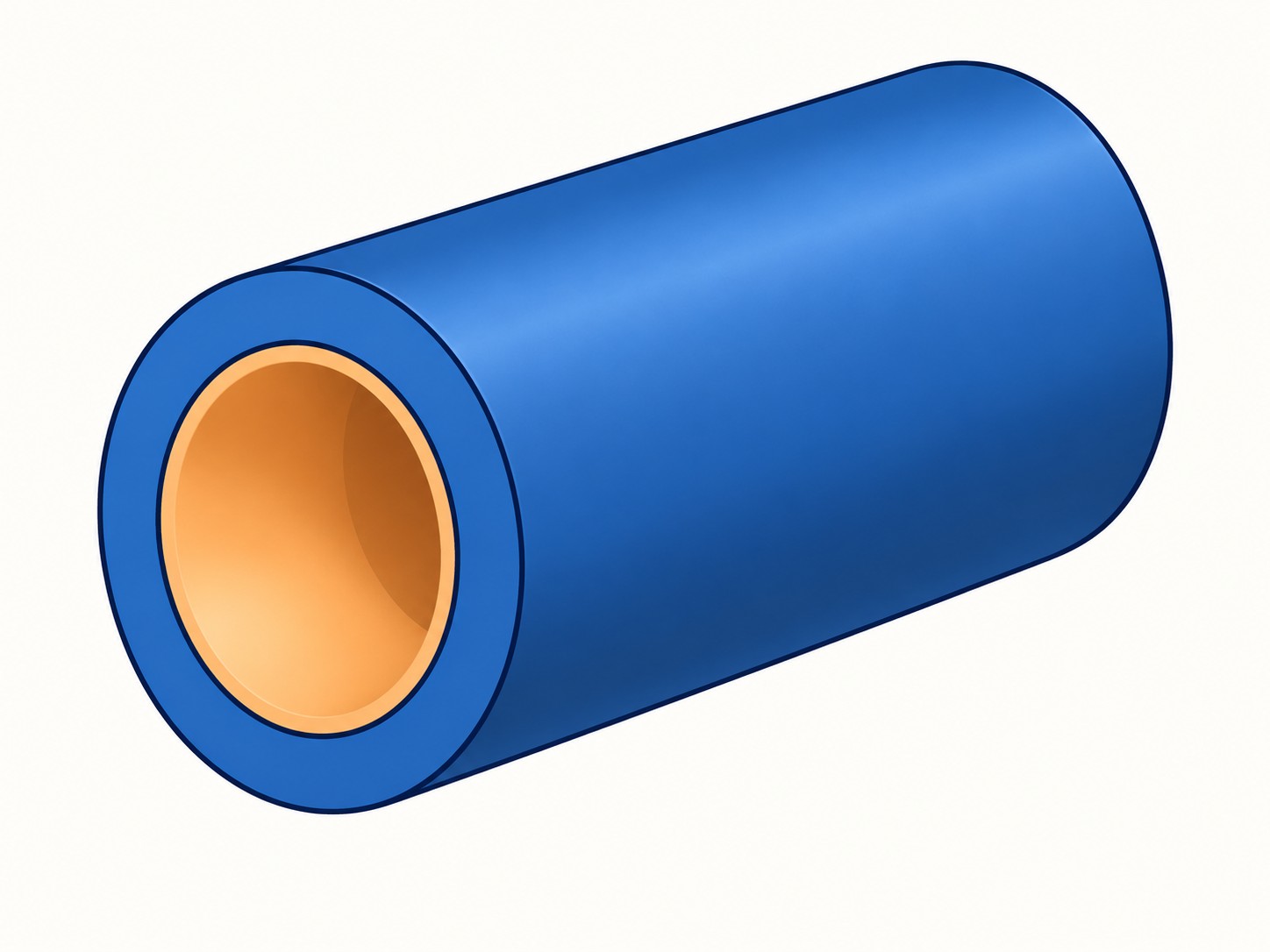
Cylinder volume and surface-area formulas
Formula focus
- Base area and circumference: $A_{\mathrm{base}}=\pi r^2$, $C=2\pi r$.
- Volume (capacity): $V=A_{\mathrm{base}}h=\pi r^2h$. Units are cubic.
- Lateral area (curved side): $LA=Ch=2\pi rh$.
- Closed total surface: $SA=2A_{\mathrm{base}}+LA$ (two bases plus curved side).
- Expanded form: $SA=2\pi r^2+2\pi rh$. Units are square.
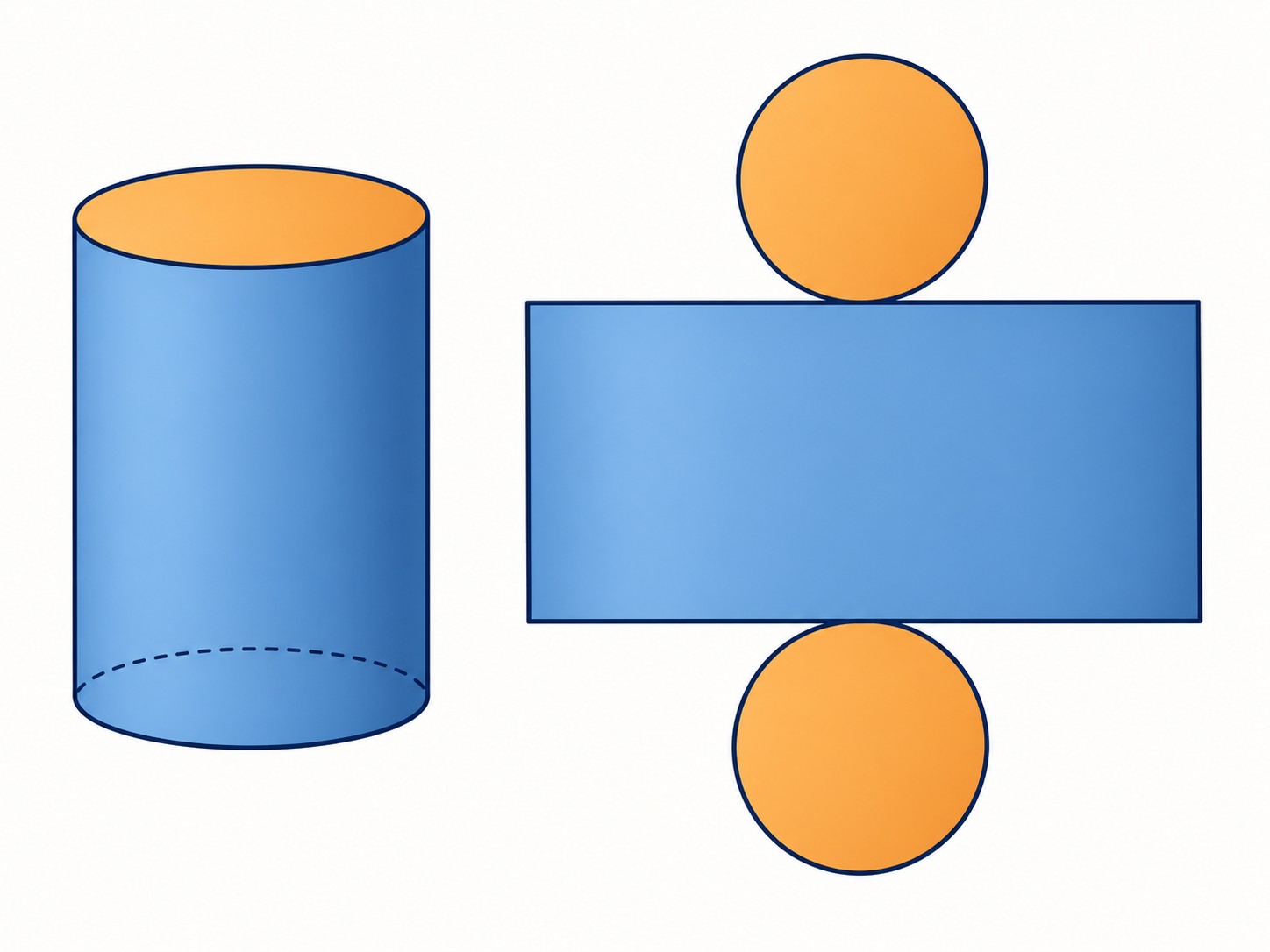
Model: diameter given, radius required
A closed cylinder has diameter $d=10$ cm and height $h=8$ cm. Find exact and approximate volume and total surface area.
- The given measure is the diameter, so $r=d/2=10/2=5$ cm.
- Volume: $V=\pi r^2h=\pi(5)^2(8)=200\pi\text{ cm}^3\approx628.32\text{ cm}^3$.
- Two bases: $2\pi r^2=50\pi\text{ cm}^2$. Curved side: $LA=2\pi rh=80\pi\text{ cm}^2$.
- Total: $SA=50\pi+80\pi=130\pi\text{ cm}^2\approx408.41\text{ cm}^2$.
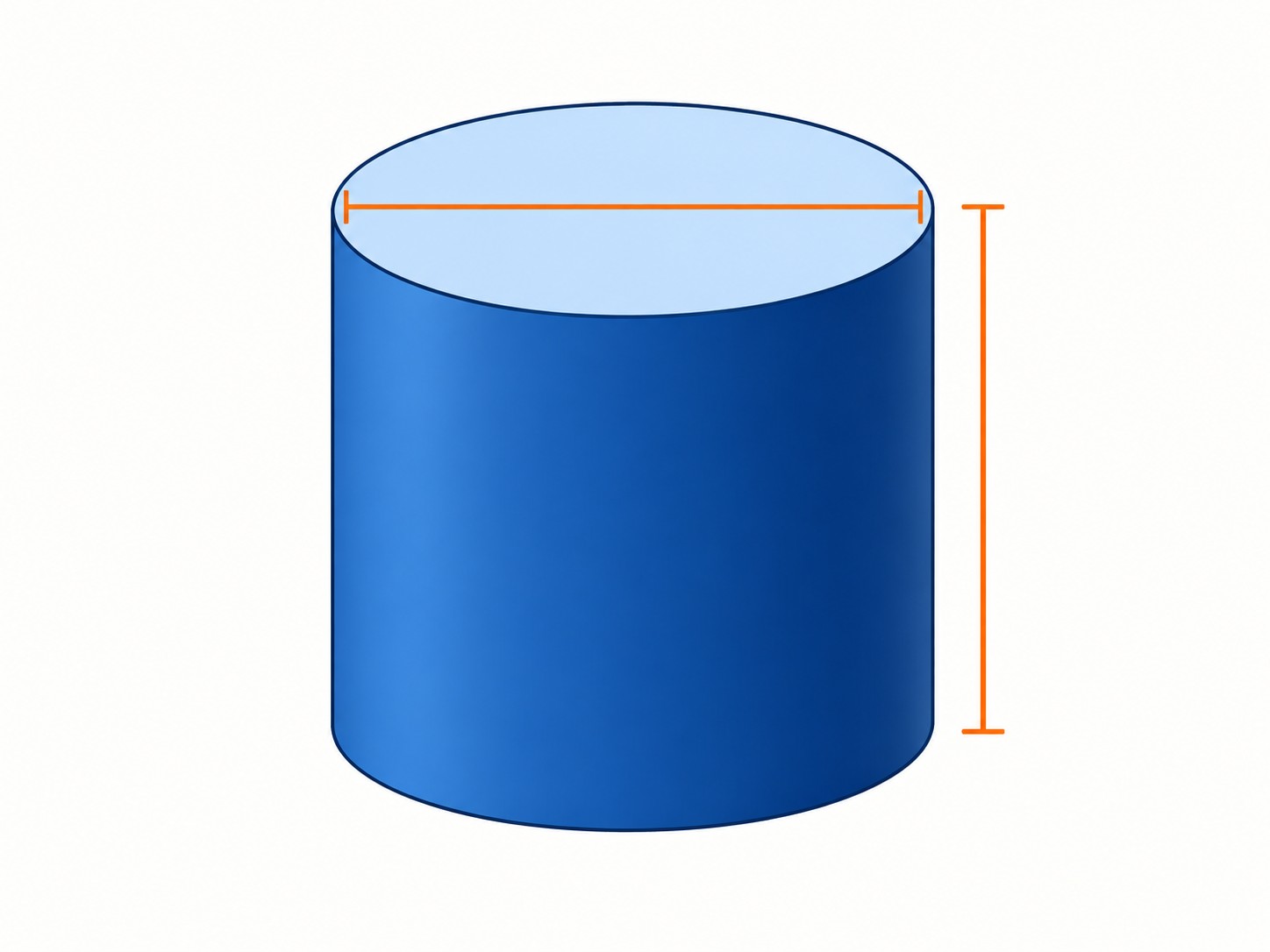
You try: closed-cylinder volume and area
Student practice
A closed cylinder has radius $r=3$ cm and height $h=10$ cm. Find exact and approximate volume and total surface area. Show the two surface-area contributions.
Feedback and solution
- $V=\pi(3)^2(10)=90\pi\text{ cm}^3\approx282.74\text{ cm}^3$.
- Two bases: $2\pi(3)^2=18\pi\text{ cm}^2$; curved side: $2\pi(3)(10)=60\pi\text{ cm}^2$.
- $SA=18\pi+60\pi=78\pi\text{ cm}^2\approx245.04\text{ cm}^2$.
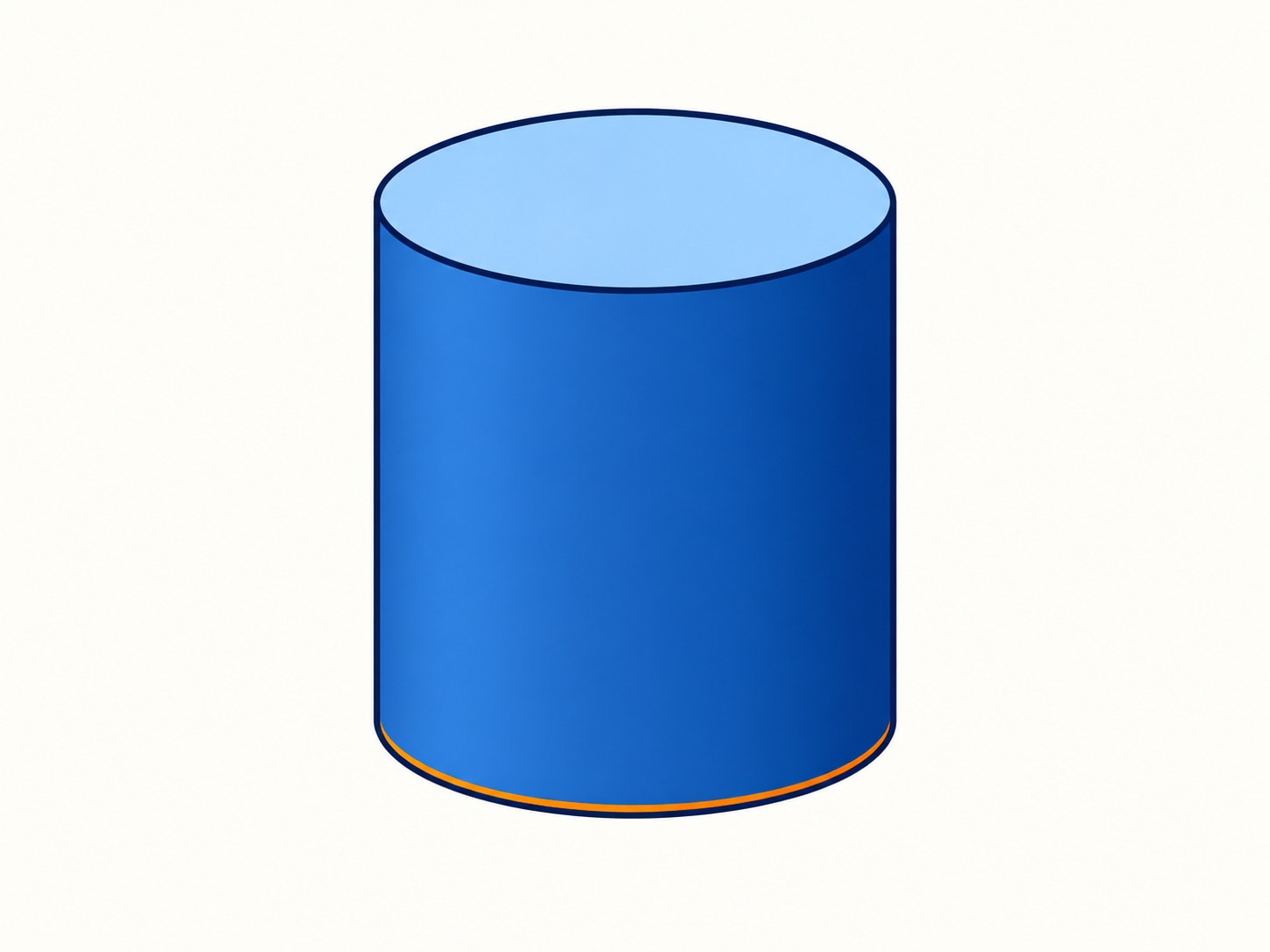
Extension: material in a hollow cylinder
A pipe segment has outer radius $R=4$ cm, inner radius $r=3$ cm, and length $h=10$ cm. Find the volume of material.
- The material cross-section is an annulus: $A_{\mathrm{material}}=\pi R^2-\pi r^2=\pi(R^2-r^2)$.
- Extend that cross-section through length $h$: $V_{\mathrm{material}}=A_{\mathrm{material}}h=\pi(R^2-r^2)h$.
- Substitute: $V=\pi(4^2-3^2)(10)=70\pi\text{ cm}^3\approx219.91\text{ cm}^3$.
- Subtract the inner circle's area, not the radii; volume uses cubic units.