MATH 130 · Section 4.3
Logarithmic Functions
Inverse relationships, graphs, equations, and applications
55 minutes · Offline capable
Today’s Learning Roadmap
- 1
convert between logarithmic and exponential forms
- 2
evaluate and simplify logarithmic expressions
- 3
graph logarithmic functions and determine their domains
- 4
solve logarithmic and exponential equations using inverse properties
Activate · 0.5 minSource: 2
Predict: convert between logarithmic and exponential forms
If $2^5=32$, what question is $\log_2(32)$ answering?
Commit to a response before discussion.
Activate · 1.0 minSource: Authored
convert between logarithmic and exponential forms
- $\log_b(x)=y$ means exactly $b^y=x$.
- The logarithm is the exponent.
Explain · 2.5 minSource: 3, 4
Model the Skill: convert between logarithmic and exponential forms
$\log_4(64)=3$ means $4^3=64$.
$4^{-3}=1/64$ means $\log_4(1/64)=-3$.
The base remains 4 and the logarithm records the exponent.
Model · 3.0 minSource: 5
You Try: convert between logarithmic and exponential forms
Rewrite $5^3=125$, $3^{-2}=1/9$, and $\ln(7)=x$ in the opposite form.
- $\log_5(125)=3$.
- $\log_3(1/9)=-2$.
- $e^x=7$.
Practice · 3.0 minSource: 6
Check and Diagnose: convert between logarithmic and exponential forms
- Keep the base unchanged.
- The log argument becomes the exponential result.
What evidence confirms the setup, sign, unit, or magnitude?
Feedback · 2.0 minSource: 7
Make It Stick: convert between logarithmic and exponential forms
Complete the sentence: a logarithm tells us ____.
Answer in complete mathematical sentences and identify one remaining question.
Synthesize · 0.5 minSource: 8
Predict: evaluate and simplify logarithmic expressions
Without a calculator, evaluate $\log_2(32)$ and $\ln(1)$.
Commit to a response before discussion.
Activate · 1.0 minSource: Authored
evaluate and simplify logarithmic expressions
- Common log has base 10; natural log has base e.
- $\log_b(1)=0$, $\log_b(b)=1$, and $\log_b(b^x)=x$.
Explain · 2.5 minSource: 9, 10
Model the Skill: evaluate and simplify logarithmic expressions
$\log(250)\approx2.398$, and $10^{2.398}\approx250$.
$\ln(40)\approx3.689$, and $e^{3.689}\approx40$.
The inverse checks confirm both calculator entries.
Model · 3.0 minSource: 11
You Try: evaluate and simplify logarithmic expressions
Simplify $\log_7(1)$, $\ln(e^{-5/2})$, and $e^{\ln 7}$.
$0$, $-5/2$, and $7$.
Practice · 3.0 minSource: 12, 13
Check and Diagnose: evaluate and simplify logarithmic expressions
- A logarithm of a number between 0 and 1 is negative when the base exceeds 1.
- Logs undo exponents only when bases match.
What evidence confirms the setup, sign, unit, or magnitude?
Feedback · 2.0 minSource: 14
Make It Stick: evaluate and simplify logarithmic expressions
Name two inverse identities involving logarithms and exponents.
Answer in complete mathematical sentences and identify one remaining question.
Synthesize · 0.5 minSource: 15
Predict: graph logarithmic functions and determine their domains
What feature of an exponential graph becomes the vertical asymptote of its inverse?
Commit to a response before discussion.
Activate · 1.0 minSource: Authored
graph logarithmic functions and determine their domains
- Logarithmic graphs reflect exponential graphs across $y=x$.
- For $f(x)=\log_b(g(x))$, require $g(x)>0$.
Explain · 2.5 minSource: 16
Model the Skill: graph logarithmic functions and determine their domains
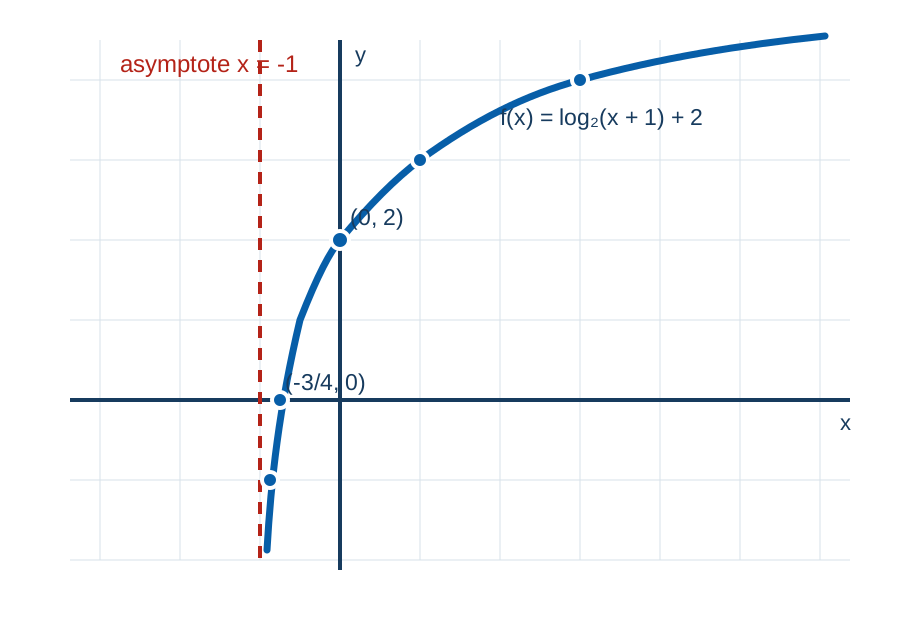
- Transform $y=\log_2(x)$ into $f(x)=\log_2(x+1)+2$.
- Shift the parent graph left 1 and up 2.
- Domain: $(-1,\infty)$; vertical asymptote: $x=-1$.
- Intercepts: $(0,2)$ and $(-3/4,0)$.
Model · 3.0 minSource: 17
You Try: graph logarithmic functions and determine their domains
Find the domain and vertical asymptote of $\log(3x-6)$.
- Require $3x-6>0$, so $x>2$.
- Domain: $(2,\infty)$; asymptote: $x=2$.
Practice · 3.0 minSource: 18
Check and Diagnose: graph logarithmic functions and determine their domains
- The logarithm argument must be strictly positive, not merely nonnegative.
- Horizontal shifts move the vertical asymptote.
What evidence confirms the setup, sign, unit, or magnitude?
Feedback · 2.0 minSource: 19
Make It Stick: graph logarithmic functions and determine their domains
Explain how to find a logarithmic domain before graphing.
Answer in complete mathematical sentences and identify one remaining question.
Synthesize · 0.5 minSource: 20
Predict: solve logarithmic and exponential equations using inverse properties
When should you convert to exponential form, and when should you take a logarithm?
Commit to a response before discussion.
Activate · 1.0 minSource: Authored
solve logarithmic and exponential equations using inverse properties
- Use exponential form for a single logarithm.
- Use one-to-one properties when equal logs have the same base.
- Use change of base: $\log_a(x)=\log(x)/\log(a)$.
Explain · 2.5 minSource: 21, 22
Model the Skill: solve logarithmic and exponential equations using inverse properties
$x-5=2^4=16$, so $x=21$; the argument $16$ is positive.
$\log_4(25)=\ln(25)/\ln(4)\approx2.322$.
Substitution and exponentiation verify both results.
Model · 3.0 minSource: 23, 24
You Try: solve logarithmic and exponential equations using inverse properties
Solve $3^x=175$ and evaluate $\log_3(50)$.
- $x=\log(175)/\log(3)\approx4.701$.
- $\log_3(50)\approx3.561$.
Practice · 3.0 minSource: 25
Check and Diagnose: solve logarithmic and exponential equations using inverse properties
- Reject solutions that make a log argument nonpositive.
- The log of a sum is not the sum of logs.
What evidence confirms the setup, sign, unit, or magnitude?
Feedback · 2.0 minSource: 26, 27
Make It Stick: solve logarithmic and exponential equations using inverse properties
Write a two-step checklist for solving and checking a logarithmic equation.
Answer in complete mathematical sentences and identify one remaining question.
Synthesize · 0.5 minSource: 28
Session Summary and Exit Ticket
- State the most important idea from today without looking at your notes.
- Complete one representative setup and identify the step most likely to cause an error.
- Write one question that should be answered before the next assessment.
Answer in complete mathematical sentences and identify one remaining question.
Use the objective roadmap to identify any skill that still needs deliberate practice.
Synthesize · 1.5 minSource: 29, 30, 31